
BPC-157
A 15-amino-acid peptide based on a protein found in gastric juice. Widely studied in animals for tissue healing; human evidence is very thin.
- sports-medicine studies were animal or lab work (2025 review)
- 35/36
- amino acids long
- 15
sports-medicine studies were animal or lab work (2025 review)[1]
amino acids long
6 sources, every claim linked. PepDose sells no peptides and takes no vendor money.
01 · What it is
What is BPC-157?
BPC-157 (body protection compound 157) is a synthetic peptide made of 15 amino acids, a fragment of a larger protein first isolated from human gastric juice.
It is not approved as a medicine anywhere in the US. It is popular with athletes and in clinics for injuries, and it is banned in professional sport.
Illustration.
02 · How it works
How does BPC-157 work?
In lab and animal work it appears to increase growth hormone receptor expression, support new blood vessel growth (angiogenesis) and lower inflammatory signals. In tendon cells it helped cells survive stress and move into injured areas.
03 · Research
What does the research on BPC-157 show?
Almost all BPC-157 research is in animals and cells. A 2025 systematic review found 36 studies relevant to sports medicine, and 35 of them were animal or lab studies. Those reported better healing in muscle, tendon, ligament and bone injuries. The human evidence is a few small, uncontrolled reports.
Where the evidence comes from
- A 2025 systematic review found 36 studies relevant to sports medicine: 35 were animal or lab studies and only 1 was a human study.[1]
- In animal models it improved healing measures in muscle, tendon, ligament and bone injuries.[1]
- In rat tendon cells it sped up cell outgrowth and migration and improved cell survival under stress.[2]
- A retrospective chart review of 16 people given knee injections reported pain relief in most of them. There was no control group and no standard measurement, so this is weak evidence.[3]
04 · Side effects
What are the side effects of BPC-157?
The side effects of BPC-157 in people are unknown. A 2025 systematic review found no clinical safety data, although animal studies did not show harm. A two-person IV pilot reported no side effects, which is far too small to establish safety. Because products are unregulated, contamination and wrong dosing are separate risks.
- The 2025 systematic review found no clinical (human) safety data. Animal safety studies did not show harm across organ systems.[1]
- A 2-person IV pilot reported no side effects or changes in blood markers at 10 and 20 mg. Two people cannot establish safety.[4]
- Because it is unregulated, contamination and wrong dosing are real risks, separate from the peptide itself.[1]
Commonly listed reasons to avoid it
- Pregnancy and breastfeeding
- Active cancer or a history of cancer
Not approved
05 · Legal and regulatory status
Is BPC-157 FDA-approved?
No. BPC-157 is not FDA-approved, and it is banned in professional sport. The FDA had listed it among compounding substances that may present significant safety risks; as of April 2026 that listing shows as withdrawn, and an FDA advisory committee discussed it in July 2026.
- Not FDA-approved. The FDA had placed BPC-157 on its list of compounding substances that may present significant safety risks; as of April 2026 that listing shows as withdrawn, and in July 2026 an FDA advisory committee discussed whether it can be used in pharmacy compounding.[5]
- Banned in professional sport.[1]
06 · Mixing and units
How do you mix BPC-157 and read the units?
Units on a U-100 syringe = dose (mg) ÷ concentration (mg/mL) × 100. For example, a 5 mg vial mixed with 2 mL of bacteriostatic water is 2.5 mg/mL, so 10 units hold 0.25 mg. Pick your vial and water below; the maths is the same for any brand of BPC-157.
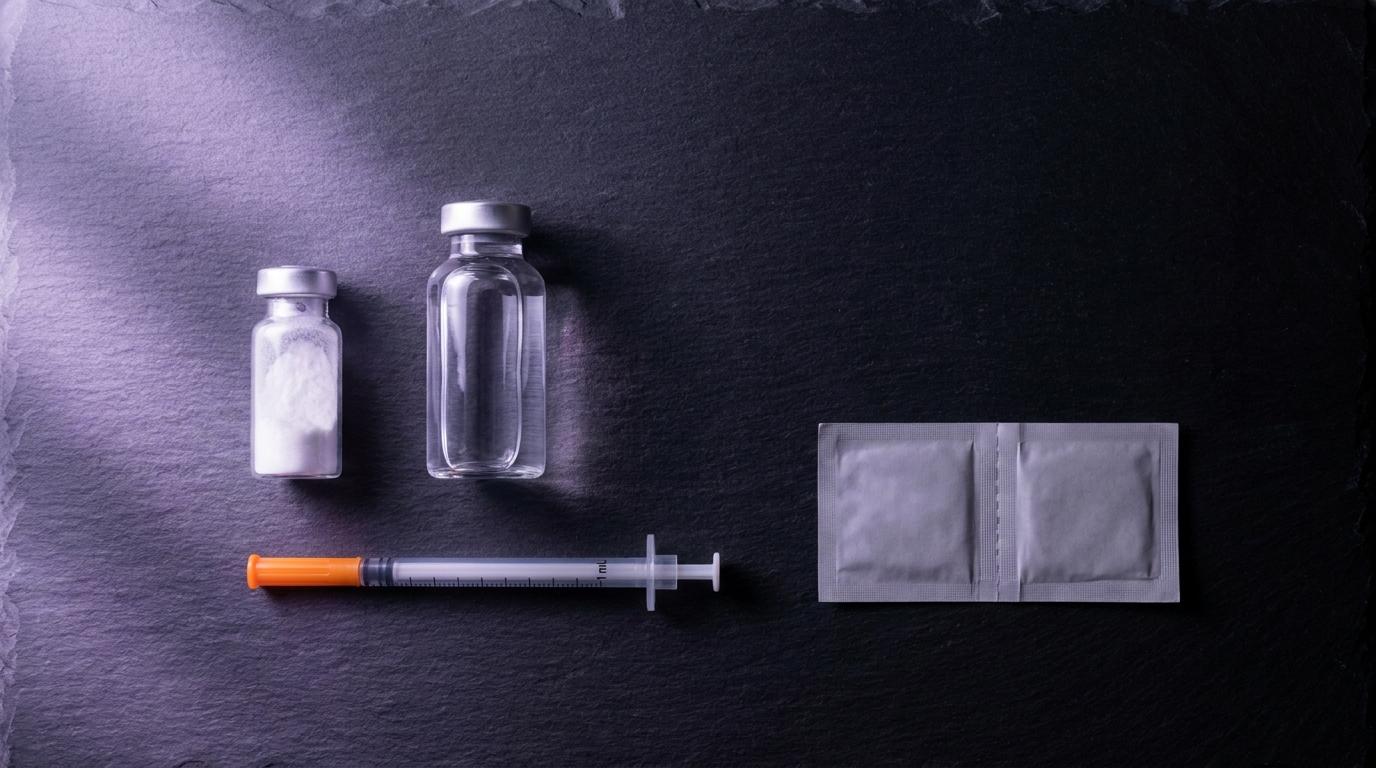
- 1 Peptide vial
- 2 Bacteriostatic water
- 3 U-100 syringe
- 4 Alcohol swabs
Vial size
Water added
- BPC-157 in the vial
- 5 mg
- Water added
- 2 mL
- Strength
- 2.5 mg/mL
- 1 unit holds
- 25 mcg
- Step 1
Clean
Wipe the vial stopper with an alcohol swab and let it dry.
- Step 2
Add water
Let the bacteriostatic water run slowly down the inside wall of the vial.
- Step 3
Swirl
Swirl or roll gently until clear. Don't shake.
- Step 4
Label and chill
Write the date and strength (mg/mL) on the vial and keep it in the fridge.
The full BPC-157 protocol
- Week-by-week schedule and titration
- What to track and when
- Stacking notes and timing
- Dose tracker with injection-site rotation
- Every study explained in detail
- Step-by-step start guide
07 · Questions
Common questions about BPC-157
How much BAC water for 10 mg of BPC-157?
2 mL is a common choice: it gives 5 mg/mL, so 10 units on a U-100 syringe holds 500 mcg and 5 units holds 250 mcg. 3 mL makes each unit weaker (3.33 mg/mL), which helps if you want small amounts to be easier to measure.
How much BAC water for 5 mg of BPC-157?
With 2 mL the vial is 2.5 mg/mL: 10 units holds 250 mcg. With 1 mL it is 5 mg/mL: 10 units holds 500 mcg.
Is BPC-157 proven to work in humans?
No. Nearly all of the evidence comes from animals and cell studies. The human data so far is a handful of small, uncontrolled reports. That is why we label it "Animal and lab data".
Is BPC-157 legal?
It is not an approved drug and cannot be sold as one or for human use. It is banned by sports anti-doping rules. The FDA's position on its use in pharmacy compounding has been under review in 2026.
What are the side effects of BPC-157?
They are not known in people. A 2025 systematic review found no clinical safety data. Animal safety studies did not show harm, and a two-person IV pilot reported no side effects, but two people cannot establish safety.
Is BPC-157 banned in sport?
Yes. BPC-157 is banned in professional sport, and it is not an approved medicine.
Sources
- 1.Emerging use of BPC-157 in orthopaedic sports medicine: a systematic review
Vasireddi N et al. HSS J 2025;21:485-495 · Review - 2.The promoting effect of BPC 157 on tendon healing
Chang CH et al. J Appl Physiol 2011;110:774-780 · Lab study - 3.Intra-articular injection of BPC 157 for multiple types of knee pain
Lee E, Padgett B. Altern Ther Health Med 2021;27:8-13 · Human, small study - 4.Safety of intravenous infusion of BPC157 in humans: a pilot study
Lee E, Burgess K. Altern Ther Health Med 2025;31:20-24 · Human, small study - 5.FDA compounding safety-risk list
FDA. Bulk drug substances for compounding that may present significant safety risks (as of Apr 22, 2026) · FDA - 6.Tirzepatide once weekly for the treatment of obesity (SURMOUNT-1)
Jastreboff AM et al. N Engl J Med 2022;387:205-216 · Human trial