GLOW blend
A pre-mixed vial of GHK-Cu, BPC-157 and TB-500. Each part has its own (mostly animal and lab) research; the blend itself has never been studied.
- peptides in one vial: GHK-Cu, BPC-157 and TB-500
- 3
- studies of the blend itself
- 0
- typical vial total
- 70 mg
peptides in one vial: GHK-Cu, BPC-157 and TB-500
studies of the blend itself
typical vial total
5 sources, every claim linked. PepDose sells no peptides and takes no vendor money.
01 · What it is
What is the GLOW blend?
GLOW is a supplier name, not a medicine. It usually means GHK-Cu combined with BPC-157 and TB-500 in one vial, for skin and recovery.
No study has tested this combination, so what it does together is unknown.
What’s in the vial: Commonly 50 mg GHK-Cu + 10 mg BPC-157 + 10 mg TB-500 in a 70 mg vial. Blend vials are sold by total weight and the split between peptides is not standardised. Read the label, then use the blend calculator to see what each draw contains.
Illustration.
What's in a typical GLOW vial
| In the vial | Total | In 10 units |
|---|---|---|
| GHK-Cu | 50 mg | 2.5 mg |
| BPC-157 | 10 mg | 0.5 mg |
| TB-500 | 10 mg | 0.5 mg |
70 mg in 2 mL = 35 mg/mL in total. 10 units on a U-100 syringe is 0.1 mL. Assumes the split on a typical label; check yours.
02 · How it works
How does the GLOW blend work?
The idea is to combine GHK-Cu's collagen effects with the tissue-repair effects reported for BPC-157 and TB-500. See each peptide's page for what its research shows.
03 · Research
What does the research on the GLOW blend show?
The GLOW blend itself has never been studied. Each part has its own research, mostly in animals and cells: GHK-Cu for collagen and tissue repair, BPC-157 for healing (35 of 36 sports-medicine studies were animal or lab work), and thymosin beta-4, the basis of TB-500, for faster wound healing in rats.
04 · Side effects
What are the side effects of the GLOW blend?
The side effects of the GLOW blend are unknown because the combination has not been studied. All three components were placed on the FDA's compounding safety-risk list for immune-reaction risk and limited human data; those listings show as withdrawn as of April 2026.
- All three components were placed on the FDA's compounding safety-risk list for immune-reaction risk and limited human data (now shown as withdrawn as of April 2026). The combination's safety has not been studied.[1]
Commonly listed reasons to avoid it
- Pregnancy and breastfeeding
- Copper metabolism disorders such as Wilson's disease
Not approved
05 · Legal and regulatory status
Is the GLOW blend FDA-approved?
No. GLOW is a supplier name, not a medicine, and it is not FDA-approved. None of its components (GHK-Cu, BPC-157 and TB-500) is an approved drug. Vials sold as GLOW are unregulated research products.
- Not FDA-approved. None of its components is an approved drug.[1]
06 · Mixing and units
How do you mix the GLOW blend and read the units?
Units on a U-100 syringe = dose (mg) ÷ concentration (mg/mL) × 100. For example, a 70 mg vial mixed with 2 mL of bacteriostatic water is 35 mg/mL in total, so 10 units hold 3.5 mg. Pick your vial and water below; the maths is the same for any brand of GLOW blend.
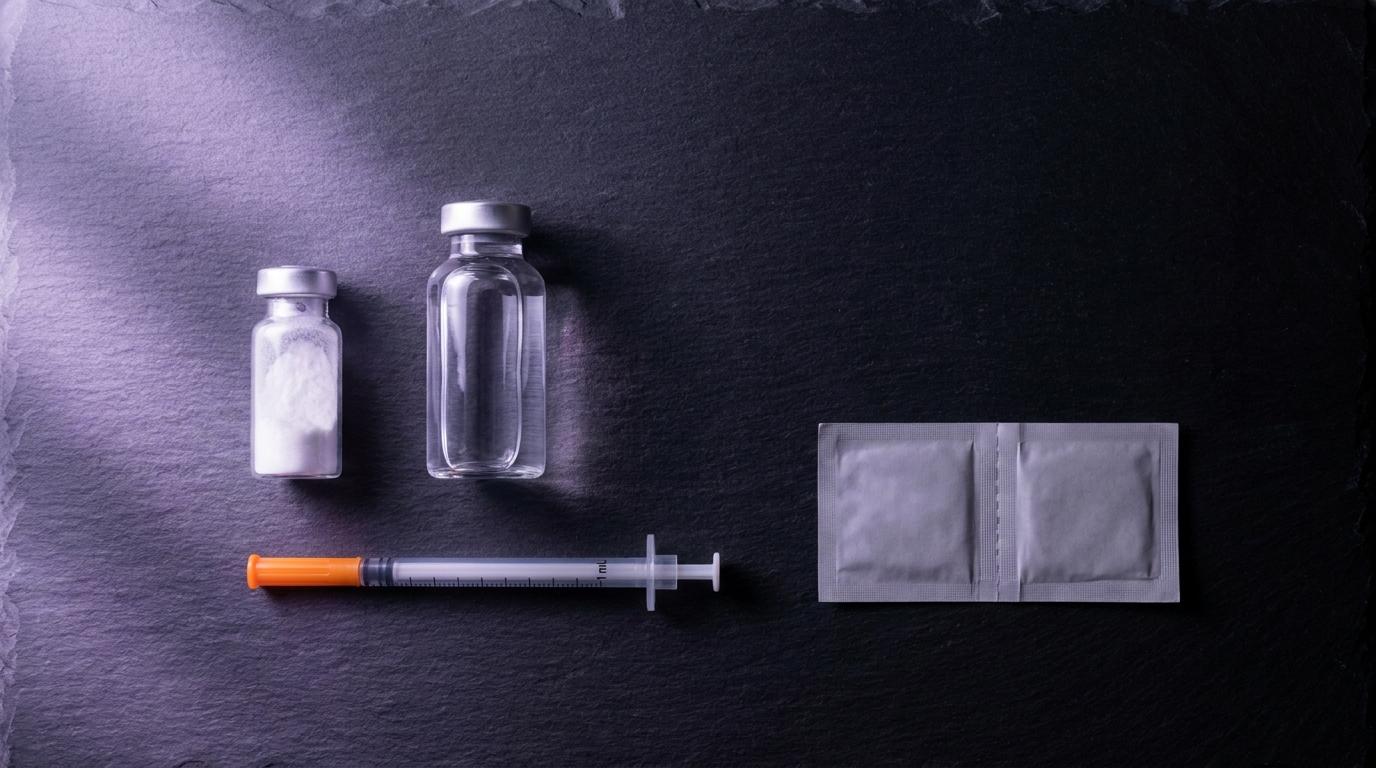
- 1 Peptide vial
- 2 Bacteriostatic water
- 3 U-100 syringe
- 4 Alcohol swabs
Vial size
Water added
- GLOW blend in the vial
- 70 mg
- Water added
- 2 mL
- Strength
- 35 mg/mL
- 1 unit holds
- 350 mcg
GLOW dosage calculator
The blend calculator works out the units to draw and what each draw holds of every ingredient. Open it with the common GLOW split already filled in; if your label says something different, the label wins.
Open the GLOW dosage calculator- Step 1
Clean
Wipe the vial stopper with an alcohol swab and let it dry.
- Step 2
Add water
Let the bacteriostatic water run slowly down the inside wall of the vial.
- Step 3
Swirl
Swirl or roll gently until clear. Don't shake.
- Step 4
Label and chill
Write the date and strength (mg/mL) on the vial and keep it in the fridge.
The full GLOW blend protocol
- Week-by-week schedule and titration
- What to track and when
- Stacking notes and timing
- Dose tracker with injection-site rotation
- Every study explained in detail
- Step-by-step start guide
07 · Questions
Common questions about the GLOW blend
How do I reconstitute a 70 mg GLOW vial?
With 2 mL the vial is 35 mg/mL in total. If it is 50/10/10, each 10 units holds about 2.5 mg GHK-Cu, 0.5 mg BPC-157 and 0.5 mg TB-500. The blend calculator works this out for any split.
GLOW vs KLOW?
KLOW is GLOW with KPV added, a small anti-inflammatory peptide studied in mouse models of colitis.
What is in the GLOW blend?
Usually GHK-Cu, BPC-157 and TB-500 in one vial, commonly 50 mg + 10 mg + 10 mg in a 70 mg vial. The split is not standardised, so read your label.
Has the GLOW blend been studied?
No. No study has tested this combination. Each part has its own research, mostly in animals and cells, so what the three do together is unknown.
Is the GLOW blend FDA-approved?
No. GLOW is a supplier name, not a medicine. None of its components is an approved drug.
How many units of GLOW with 3 mL of water?
A 70 mg vial with 3 mL is about 23.3 mg/mL in total. If it is 50/10/10, each 10 units holds about 1.67 mg GHK-Cu, 0.33 mg BPC-157 and 0.33 mg TB-500.
Sources
- 1.FDA compounding safety-risk list
FDA. Bulk drug substances for compounding that may present significant safety risks (as of Apr 22, 2026) · FDA - 2.Regenerative and protective actions of the GHK-Cu peptide in the light of the new gene data
Pickart L, Margolina A. Int J Mol Sci 2018;19:1987 · Review - 3.Emerging use of BPC-157 in orthopaedic sports medicine: a systematic review
Vasireddi N et al. HSS J 2025;21:485-495 · Review - 4.Thymosin beta4 accelerates wound healing
Malinda KM et al. J Invest Dermatol 1999;113:364-368 · Animal study - 5.Thymosin β4: a multi-functional regenerative peptide
Goldstein AL et al. Expert Opin Biol Ther 2012;12:37-51 · Review