
CJC-1295 + Ipamorelin
A pairing of two growth-hormone-releasing peptides: CJC-1295 (a GHRH analog) and ipamorelin (a ghrelin-receptor agonist). Neither is approved.
- growth hormone rise for 6+ days after one CJC-1295 (with DAC) shot
- 2–10×
- surgical patients in the ipamorelin phase 2 trial
- 114
- ipamorelin is still on the FDA's compounding risk list
- Not approved
growth hormone rise for 6+ days after one CJC-1295 (with DAC) shot[1]
surgical patients in the ipamorelin phase 2 trial[2]
ipamorelin is still on the FDA's compounding risk list[3]
4 sources, every claim linked. PepDose sells no peptides and takes no vendor money.
01 · What it is
What is CJC-1295 + Ipamorelin?
CJC-1295 is a modified version of growth-hormone-releasing hormone (GHRH). The original version has a "DAC" add-on that makes it last for days; the version usually paired with ipamorelin is "no DAC" (also called modified GRF 1-29), which is short-acting.
Ipamorelin is a five-amino-acid peptide that triggers growth hormone release through the ghrelin receptor. The two are often sold pre-mixed in one vial.
What’s in the vial: Usually 5 mg CJC-1295 (no DAC) + 5 mg ipamorelin in one 10 mg vial. Blend vials are sold by total weight and the split between peptides is not standardised. Read the label, then use the blend calculator to see what each draw contains.
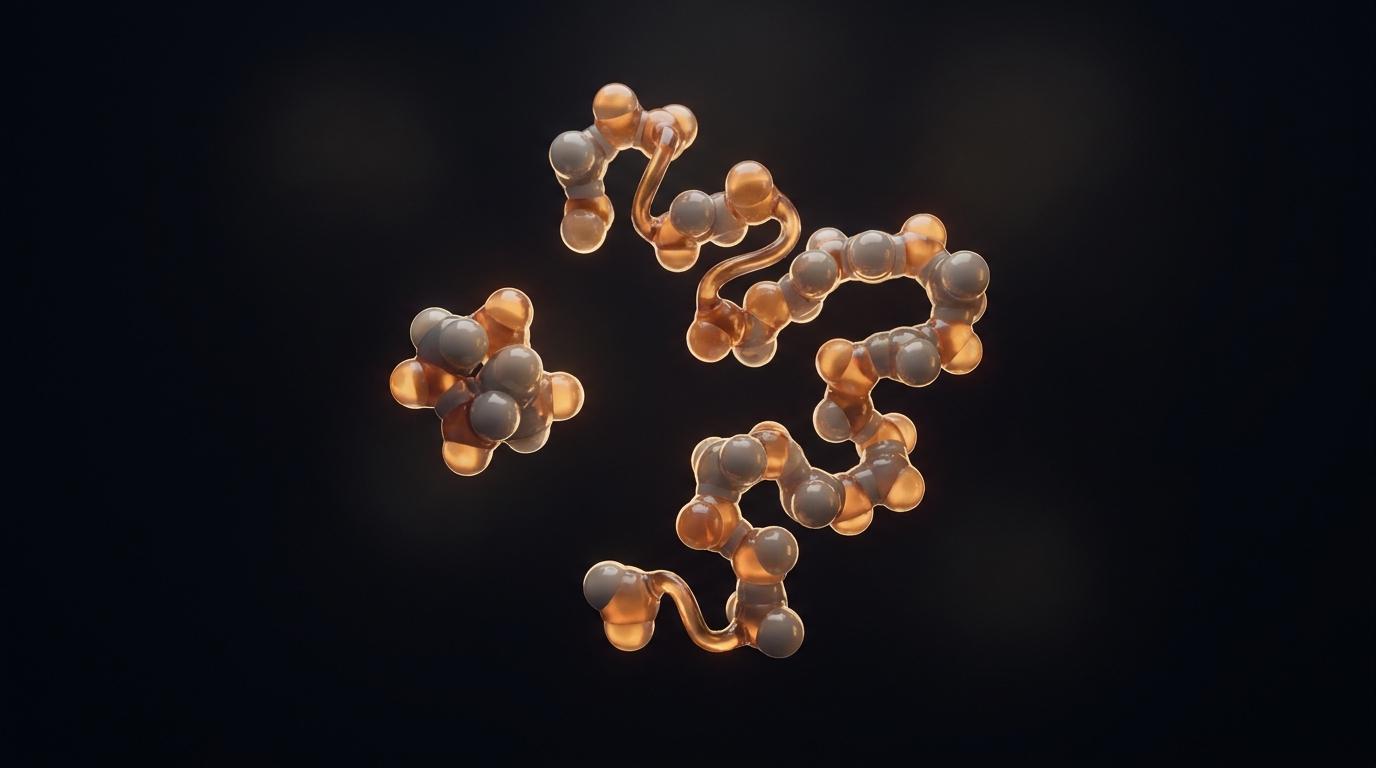
Illustration.
02 · How it works
How does CJC-1295 + Ipamorelin work?
They push the pituitary gland to release growth hormone by two different routes. CJC-1295 acts on the GHRH receptor. Ipamorelin acts on the ghrelin (GHS) receptor. More growth hormone then raises IGF-1.
Two different doors on the same gland. Tap a peptide to see which receptor it uses. Schematic.
03 · Research
What does the research on CJC-1295 + Ipamorelin show?
Human data is limited and comes from each peptide on its own, not the pair. A single injection of CJC-1295 with DAC raised growth hormone 2 to 10 times for 6 days or more in healthy adults. Ipamorelin was well tolerated in a 114-patient phase 2 trial but did not speed bowel recovery after surgery.
With DAC vs without: how long one dose lasts
Half-life 5.8 to 8.1 days, after a single injection in healthy adults.[1]
CJC-1295 without DAC (what blends usually contain)
- In healthy adults, a single injection of CJC-1295 (with DAC) raised growth hormone 2 to 10 times for 6 days or more and IGF-1 1.5 to 3 times for 9 to 11 days. Its half-life was 5.8 to 8.1 days. Note: this is the long-acting DAC version.[1]
- In animal studies, ipamorelin released growth hormone without raising cortisol or ACTH, even at high doses, unlike older peptides such as GHRP-6.[4]
- A phase 2 trial in 114 surgical patients found ipamorelin well tolerated, but it did not speed recovery of bowel function compared with placebo.[2]
04 · Side effects
What are the side effects of CJC-1295 + Ipamorelin?
No serious adverse reactions were reported in the CJC-1295 trials in healthy adults. The FDA lists ipamorelin as a compounding substance that may present significant safety risks, citing immune reactions and serious adverse event reports. CJC-1295 was listed for events including increased heart rate; that listing shows as withdrawn as of April 2026.
- No serious adverse reactions were reported in the CJC-1295 healthy-adult trials.[1]
- The FDA lists ipamorelin as a compounding substance that may present significant safety risks, citing immune reactions and serious adverse event reports. CJC-1295 was listed for serious adverse events including increased heart rate; as of April 2026 that CJC-1295 listing shows as withdrawn.[3]
Commonly listed reasons to avoid it
- Active cancer or a history of cancer
- Pregnancy and breastfeeding, or diabetes without medical supervision
Not approved
05 · Legal and regulatory status
Is CJC-1295 + Ipamorelin FDA-approved?
No. Neither CJC-1295 nor ipamorelin is FDA-approved. As of April 2026, ipamorelin remains on the FDA's list of compounding substances that may present significant safety risks, while the CJC-1295 listing shows as withdrawn. Vials sold online are unregulated research products.
- Neither is FDA-approved. As of April 2026, ipamorelin remains on the FDA's compounding safety-risk list.[3]
06 · Mixing and units
How do you mix CJC-1295 + Ipamorelin and read the units?
Units on a U-100 syringe = dose (mg) ÷ concentration (mg/mL) × 100. For example, a 10 mg vial mixed with 2 mL of bacteriostatic water is 5 mg/mL in total, so 10 units hold 0.5 mg. Pick your vial and water below; the maths is the same for any brand of CJC-1295 + Ipamorelin.
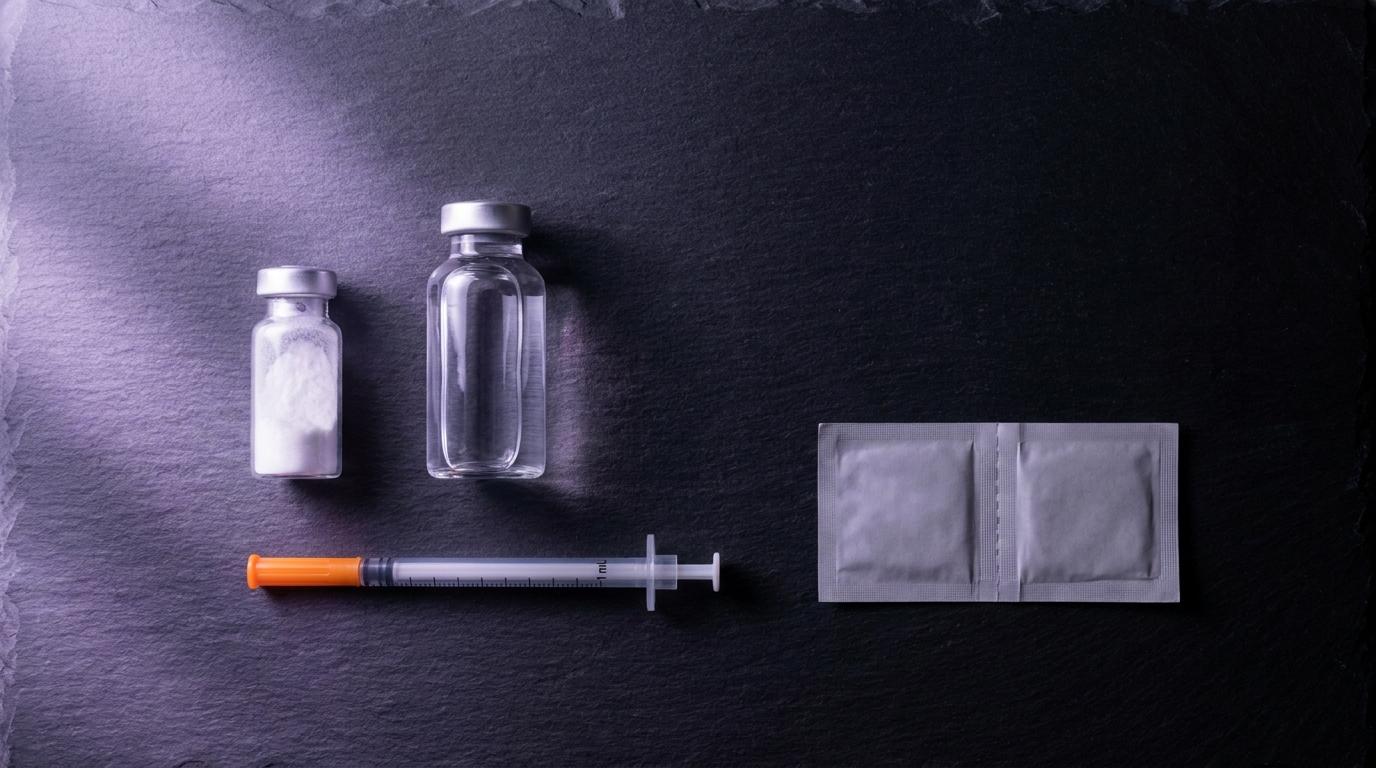
- 1 Peptide vial
- 2 Bacteriostatic water
- 3 U-100 syringe
- 4 Alcohol swabs
Vial size
Water added
- CJC-1295 + Ipamorelin in the vial
- 10 mg
- Water added
- 2 mL
- Strength
- 5 mg/mL
- 1 unit holds
- 50 mcg
- Step 1
Clean
Wipe the vial stopper with an alcohol swab and let it dry.
- Step 2
Add water
Let the bacteriostatic water run slowly down the inside wall of the vial.
- Step 3
Swirl
Swirl or roll gently until clear. Don't shake.
- Step 4
Label and chill
Write the date and strength (mg/mL) on the vial and keep it in the fridge.
The full CJC-1295 + Ipamorelin protocol
- Week-by-week schedule and titration
- What to track and when
- Stacking notes and timing
- Dose tracker with injection-site rotation
- Every study explained in detail
- Step-by-step start guide
07 · Questions
Common questions about CJC-1295 + Ipamorelin
How do I reconstitute a CJC-1295/ipamorelin 10 mg vial?
With 2 mL of water the vial is 5 mg/mL in total. If it is a 5 + 5 mg split, each 10 units holds 250 mcg of each peptide. The blend calculator shows this for any split.
CJC-1295 with DAC vs no DAC?
DAC makes the peptide bind to albumin in the blood, so it lasts days instead of minutes. The human study above used the DAC version. The no-DAC version is what blends usually contain.
Is ipamorelin safe?
It was well tolerated in one 7-day hospital trial, but it has not been studied long term and the FDA keeps it on its compounding safety-risk list.
What does CJC-1295 with ipamorelin do?
Both push the pituitary gland to release growth hormone, by different routes. CJC-1295 acts on the GHRH receptor and ipamorelin acts on the ghrelin receptor. More growth hormone then raises IGF-1.
Is CJC-1295 with ipamorelin FDA-approved?
No. Neither peptide is FDA-approved. As of April 2026, ipamorelin remains on the FDA's compounding safety-risk list, while the CJC-1295 listing shows as withdrawn.
Does ipamorelin raise cortisol?
In animal studies, ipamorelin released growth hormone without raising cortisol or ACTH, even at high doses, unlike older peptides such as GHRP-6. That finding comes from animals, not from long-term human trials.
Sources
- 1.Prolonged stimulation of GH and IGF-I secretion by CJC-1295 in healthy adults
Teichman SL et al. J Clin Endocrinol Metab 2006;91:799-805 · Human trial - 2.Ipamorelin for postoperative ileus in bowel resection patients: a phase 2 trial
Beck DE et al. Int J Colorectal Dis 2014;29:1527-1534 · Human trial - 3.FDA compounding safety-risk list
FDA. Bulk drug substances for compounding that may present significant safety risks (as of Apr 22, 2026) · FDA - 4.Ipamorelin, the first selective growth hormone secretagogue
Raun K et al. Eur J Endocrinol 1998;139:552-561 · Animal study