Tirzepatide
A once-weekly injection that acts on two gut hormone receptors (GIP and GLP-1). Approved in the US as Mounjaro for type 2 diabetes and Zepbound for weight management.
- hormone receptors: GIP and GLP-1
- 2
hormone receptors: GIP and GLP-1
4 sources, every claim linked. PepDose sells no peptides and takes no vendor money.
01 · What it is
What is Tirzepatide?
Tirzepatide is a synthetic peptide given as a once-weekly injection under the skin. It is the active ingredient in two prescription medicines made by Eli Lilly: Mounjaro (type 2 diabetes) and Zepbound (chronic weight management).
Outside prescriptions, tirzepatide is also sold as a lyophilised research powder that has to be mixed with bacteriostatic water. Those products are not the approved medicine and are not checked by the FDA.

Illustration. A peptide is a short chain of amino acids.
02 · How it works
How does Tirzepatide work?
It activates the receptors for two hormones the gut releases after eating, GIP and GLP-1. According to the FDA label, this lowers appetite and food intake. It also helps the pancreas release insulin when blood sugar is high.
Tap a drug to compare. Each extra receptor adds another hormone signal. More receptors does not by itself mean safer or better.
03 · Research
What does the research on Tirzepatide show?
−20.9%
Weight change at 72 weeks on 15 mg in SURMOUNT-1 (2,539 adults with obesity, no diabetes). Placebo: −3.1%.[1]
In SURMOUNT-1, adults with obesity lost an average of 15.0% to 20.9% of their body weight over 72 weeks on tirzepatide, versus 3.1% on placebo. In SURPASS-2 every dose lowered HbA1c more than semaglutide 1 mg in type 2 diabetes, and in SURMOUNT-5 it led to more weight loss than semaglutide.
SURMOUNT-1: weight change at 72 weeks[1]
Phase 3 · 2,539 adults with obesity, no diabetes
SURMOUNT-1: lost 20% or more of body weight[1]
% of people at 72 weeks (not reported for 5 mg)
SURPASS-2: HbA1c change at 40 weeks[3]
Phase 3 · 1,879 people with type 2 diabetes · percentage points
- In SURPASS-2 (1,879 people with type 2 diabetes, 40 weeks), every tirzepatide dose lowered HbA1c more than semaglutide 1 mg, and weight loss was 1.9 to 5.5 kg greater.[3]
- In SURMOUNT-5 (751 adults with obesity, no diabetes, 72 weeks), a head-to-head trial at the highest tolerated doses, average weight change was −20.2% on tirzepatide versus −13.7% on semaglutide. The trial was open-label and funded by Eli Lilly.[4]
All findings, in words
- In SURMOUNT-1 (2,539 adults with obesity, no diabetes, 72 weeks), average weight change was −15.0% on 5 mg, −19.5% on 10 mg and −20.9% on 15 mg weekly, versus −3.1% on placebo.[1]
- In the same trial, 50% (10 mg) and 57% (15 mg) of participants lost 20% or more of their body weight, compared with 3% on placebo.[1]
- In SURPASS-2 (1,879 people with type 2 diabetes, 40 weeks), every tirzepatide dose lowered HbA1c more than semaglutide 1 mg, and weight loss was 1.9 to 5.5 kg greater.[3]
- In SURMOUNT-5 (751 adults with obesity, no diabetes, 72 weeks), a head-to-head trial at the highest tolerated doses, average weight change was −20.2% on tirzepatide versus −13.7% on semaglutide. The trial was open-label and funded by Eli Lilly.[4]
04 · Side effects
What are the side effects of Tirzepatide?
The most common side effects of tirzepatide are gastrointestinal: nausea, diarrhea, vomiting and constipation, mostly mild to moderate and mostly during dose increases. In SURMOUNT-1, 4.3% to 7.1% of people stopped because of side effects, versus 2.6% on placebo. The FDA label carries a boxed warning about thyroid C-cell tumours.
Stopped because of side effects[1]
SURMOUNT-1 · % of people, 72 weeks
- Placebo
- 5 mg
- 10 mg
- 15 mg
Stopped due to side effects
- The most common side effects in trials were gastrointestinal (nausea, diarrhea, vomiting, constipation), mostly mild to moderate and mostly during dose increases.[1,3]
- The FDA label carries a boxed warning about thyroid C-cell tumours seen in rodents, and says not to use it with a personal or family history of medullary thyroid carcinoma or MEN 2.[2]
Commonly listed reasons to avoid it
- Personal or family history of medullary thyroid carcinoma or MEN 2
- History of pancreatitis, or pregnancy and breastfeeding
Approved
05 · Legal and regulatory status
Is Tirzepatide FDA-approved?
Yes. Tirzepatide is FDA-approved as Mounjaro for type 2 diabetes (2022) and as Zepbound for chronic weight management (2023). Both are prescription medicines made by Eli Lilly. Tirzepatide sold as a research powder is not the approved medicine and is not checked by the FDA.
- FDA-approved as Zepbound for chronic weight management (2023) and as Mounjaro for type 2 diabetes (2022). The approved dose is increased step by step over 4 to 20 weeks to 5, 10 or 15 mg once weekly.[2]
06 · Mixing and units
How do you mix Tirzepatide and read the units?
Units on a U-100 syringe = dose (mg) ÷ concentration (mg/mL) × 100. For example, a 10 mg vial mixed with 2 mL of bacteriostatic water is 5 mg/mL, so 10 units hold 0.5 mg. Pick your vial and water below; the maths is the same for any brand of Tirzepatide.
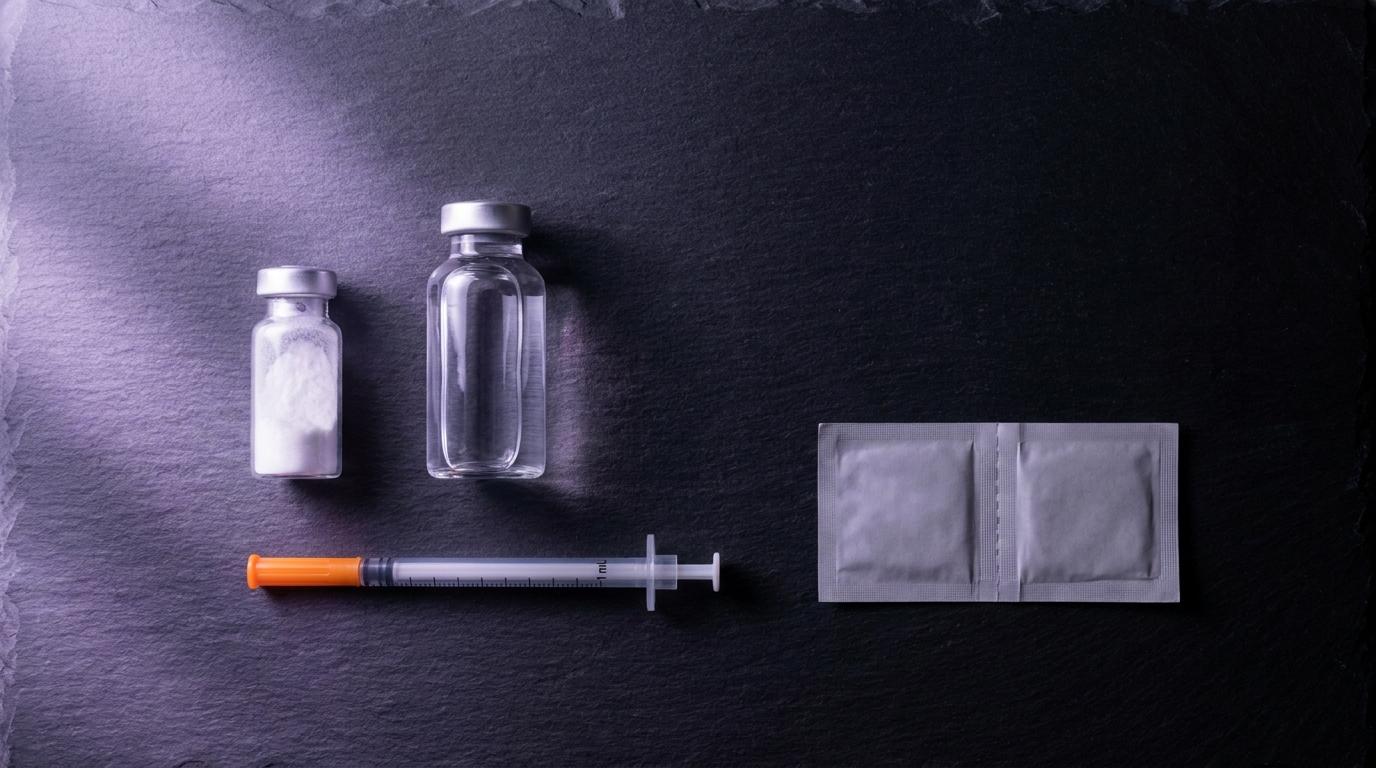
- 1 Peptide vial
- 2 Bacteriostatic water
- 3 U-100 syringe
- 4 Alcohol swabs
Vial size
Water added
- Tirzepatide in the vial
- 10 mg
- Water added
- 2 mL
- Strength
- 5 mg/mL
- 1 unit holds
- 50 mcg
Where the doses used in studies land on a 1 mL (100 unit) syringe
Shown to help you read the units, not as advice.
- 2.5 mg (starting step)50 units
- 5 mg100 units
- 7.5 mg (step)over 100 units
- 10 mgover 100 units
- 12.5 mg (step)over 100 units
- 15 mgover 100 units
Over 100 units means more than one full 1 mL syringe at this strength. Less water makes each unit stronger.
Weekly doses used in SURMOUNT-1, reached by stepping up from 2.5 mg over a 20-week escalation. Shown to help you read the units, not as advice.[1]
Tirzepatide dosing chart in units- Step 1
Clean
Wipe the vial stopper with an alcohol swab and let it dry.
- Step 2
Add water
Let the bacteriostatic water run slowly down the inside wall of the vial.
- Step 3
Swirl
Swirl or roll gently until clear. Don't shake.
- Step 4
Label and chill
Write the date and strength (mg/mL) on the vial and keep it in the fridge.
The full Tirzepatide protocol
- Week-by-week schedule and titration
- What to track and when
- Stacking notes and timing
- Dose tracker with injection-site rotation
- Every study explained in detail
- Step-by-step start guide
07 · Questions
Common questions about Tirzepatide
How many units is 2.5 mg of tirzepatide?
It depends on how much water is in the vial. In a 10 mg vial mixed with 2 mL (5 mg/mL), 2.5 mg is 50 units on a U-100 syringe. In a 30 mg vial mixed with 3 mL (10 mg/mL), it is 25 units. The chart above covers each common vial.
How much bacteriostatic water for a 30 mg tirzepatide vial?
There is no single correct amount. 3 mL gives 10 mg/mL, which makes 1 unit equal to 0.1 mg and keeps the maths simple. Use the BAC water calculator if you want a specific dose to land on a particular syringe mark.
Is tirzepatide the same as Mounjaro and Zepbound?
Tirzepatide is the active ingredient in both. Mounjaro and Zepbound are the FDA-approved, pharmacy-made pens. Research-grade powder sold online is not the approved product and has no FDA quality checks.
Is tirzepatide stronger than semaglutide?
In the two head-to-head trials, yes. In SURMOUNT-5 (obesity, 72 weeks) average weight change was −20.2% on tirzepatide versus −13.7% on semaglutide at the highest tolerated doses. In SURPASS-2 (type 2 diabetes) all three tirzepatide doses lowered HbA1c and weight more than semaglutide 1 mg.
What is tirzepatide used for?
It is FDA-approved as Mounjaro for type 2 diabetes and as Zepbound for chronic weight management. Both are once-weekly injections under the skin, made by Eli Lilly.
How much weight do people lose on tirzepatide?
In SURMOUNT-1, a 72-week trial in 2,539 adults with obesity, average weight change was −15.0% on 5 mg, −19.5% on 10 mg and −20.9% on 15 mg weekly, versus −3.1% on placebo. On 15 mg, 57% of people lost 20% or more of their body weight.
What are the most common side effects of tirzepatide?
Nausea, diarrhea, vomiting and constipation. In the trials they were mostly mild to moderate and happened mostly while the dose was being increased. In SURMOUNT-1, 4.3% to 7.1% of people stopped because of side effects, versus 2.6% on placebo.
Sources
- 1.Tirzepatide once weekly for the treatment of obesity (SURMOUNT-1)
Jastreboff AM et al. N Engl J Med 2022;387:205-216 · Human trial - 2.Zepbound label
FDA. Zepbound (tirzepatide) prescribing information, 2024 · FDA - 3.Tirzepatide versus semaglutide once weekly in patients with type 2 diabetes (SURPASS-2)
Frías JP et al. N Engl J Med 2021;385:503-515 · Human trial - 4.Tirzepatide as compared with semaglutide for the treatment of obesity (SURMOUNT-5)
Aronne LJ et al. N Engl J Med 2025;393:26-36 · Human trial