
Tesamorelin
A growth-hormone-releasing hormone (GHRH) analog. FDA-approved as Egrifta to reduce excess belly fat in people with HIV-associated lipodystrophy.
- visceral (deep belly) fat change on 2 mg daily over 26 weeks; placebo +5.0%
- −15.2%
- weeks the fat reduction held in people who kept taking it
- 52
visceral (deep belly) fat change on 2 mg daily over 26 weeks; placebo +5.0%[1]
weeks the fat reduction held in people who kept taking it[2]
3 sources, every claim linked. PepDose sells no peptides and takes no vendor money.
01 · What it is
What is Tesamorelin?
Tesamorelin is a synthetic version of the full 44-amino-acid GHRH molecule with a small change that makes it more stable. It is sold on prescription as Egrifta SV.
Use outside that approved purpose is off-label, and research-grade powder is not the approved product.

Illustration.
02 · How it works
How does Tesamorelin work?
It signals the pituitary to release more of the body's own growth hormone, which raises IGF-1 and shifts fat metabolism. The trials found it reduced deep abdominal (visceral) fat without much change to fat under the skin.
Where the fat came off

03 · Research
What does the research on Tesamorelin show?
−15.2%
Visceral fat change at 26 weeks on 2 mg in Phase 3, NEJM 2007 (412 people with HIV and excess belly fat). Placebo: +5.0%.[1]
In a phase 3 trial of 412 people with HIV and excess abdominal fat, tesamorelin 2 mg daily reduced visceral (deep belly) fat by 15.2% over 26 weeks, while it rose 5.0% on placebo. A pooled analysis of 806 people found the reduction held to 52 weeks. Its effect on overall body weight is neutral.
Phase 3, NEJM 2007: visceral fat change at 26 weeks[1]
412 people with HIV and excess belly fat
Triglyceride change at 26 weeks[1]
Same trial · mg per deciliter
Pooled phase 3: visceral fat change at 26 weeks[2]
806 people across two trials · area on CT scan, cm²
All findings, in words
- In 412 people with HIV and excess abdominal fat, 2 mg daily for 26 weeks reduced visceral fat by 15.2%, while it rose 5.0% on placebo. Triglycerides and cholesterol ratios also improved.[1]
- A pooled analysis of two phase 3 trials (806 people) found visceral fat fell by about 15% more than placebo, with the reduction maintained to 52 weeks in those who continued.[2]
- The FDA label states it is not for weight loss: its effect on overall body weight is neutral.[3]
04 · Side effects
What are the side effects of Tesamorelin?
In the main trial, adverse events overall did not differ from placebo, but more people on tesamorelin withdrew because of one. IGF-1 rose by about 81%. The FDA label says not to use it with active cancer, pituitary or hypothalamus problems, or during pregnancy.
- In the main trial adverse events overall did not differ from placebo, but more people on tesamorelin withdrew because of an adverse event.[1]
- IGF-1 rose by about 81%. The label says not to use it with active cancer, pituitary or hypothalamus problems, or pregnancy.[1,3]
- No clinically meaningful changes in blood sugar measures were seen over 52 weeks.[2]
Commonly listed reasons to avoid it
- Active cancer or a history of cancer
- Pregnancy and breastfeeding, or diabetes without medical supervision
Approved
05 · Legal and regulatory status
Is Tesamorelin FDA-approved?
Yes, for one purpose. Tesamorelin was FDA-approved in 2010 as Egrifta to reduce excess abdominal fat in adults with HIV and lipodystrophy. The current Egrifta SV dose is 1.4 mg daily. Any other use is off-label, and research-grade powder is not the approved product.
- FDA-approved (2010) as Egrifta for reducing excess abdominal fat in adults with HIV and lipodystrophy. The current Egrifta SV dose is 1.4 mg daily.[3]
06 · Mixing and units
How do you mix Tesamorelin and read the units?
Units on a U-100 syringe = dose (mg) ÷ concentration (mg/mL) × 100. For example, a 5 mg vial mixed with 1 mL of bacteriostatic water is 5 mg/mL, so 10 units hold 0.5 mg. Pick your vial and water below; the maths is the same for any brand of Tesamorelin.
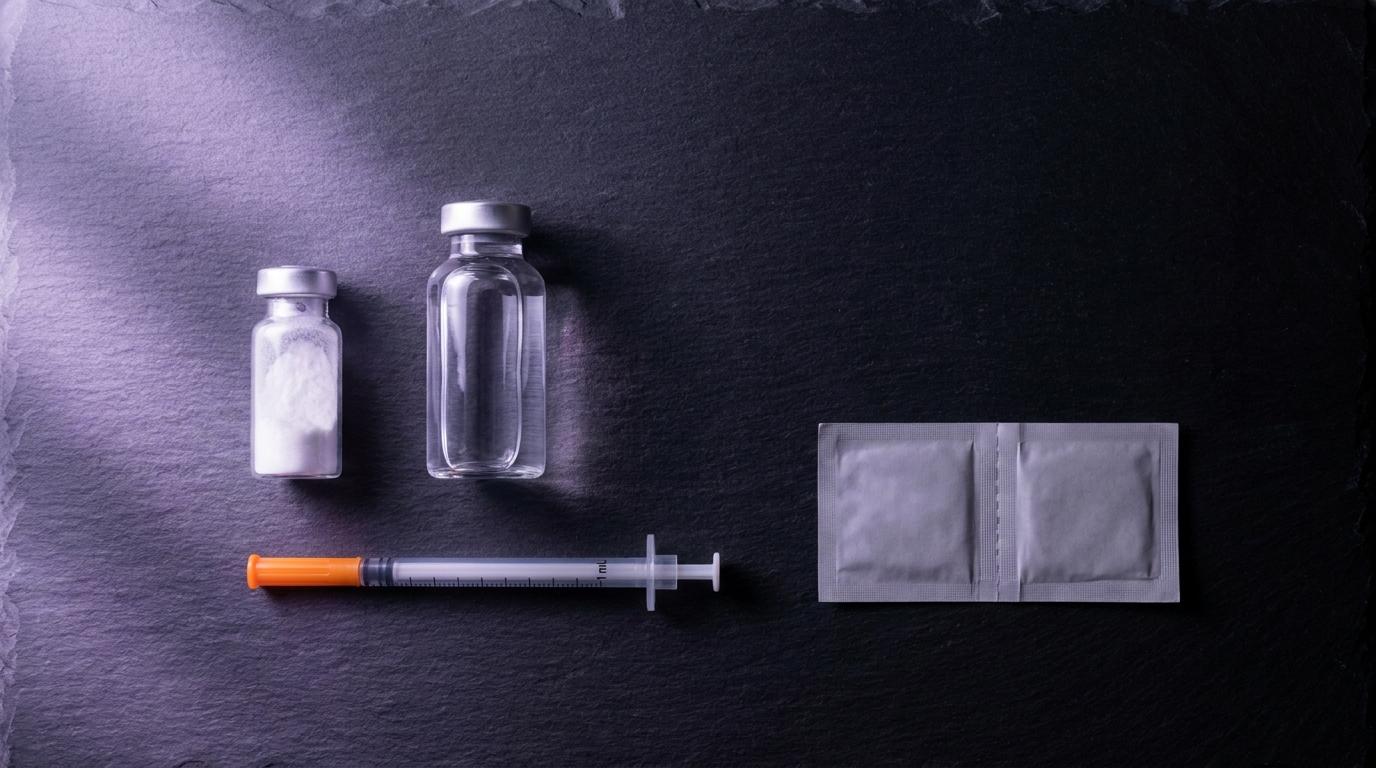
- 1 Peptide vial
- 2 Bacteriostatic water
- 3 U-100 syringe
- 4 Alcohol swabs
Vial size
Water added
- Tesamorelin in the vial
- 5 mg
- Water added
- 1 mL
- Strength
- 5 mg/mL
- 1 unit holds
- 50 mcg
Where the doses used in studies land on a 1 mL (100 unit) syringe
Shown to help you read the units, not as advice.
- 1 mg20 units
- 1.4 mg (Egrifta SV label)28 units
- 2 mg (phase 3 trials)40 units
Daily doses from the trials and the current label. Shown to help you read the units, not as advice.[1,3]
- Step 1
Clean
Wipe the vial stopper with an alcohol swab and let it dry.
- Step 2
Add water
Let the bacteriostatic water run slowly down the inside wall of the vial.
- Step 3
Swirl
Swirl or roll gently until clear. Don't shake.
- Step 4
Label and chill
Write the date and strength (mg/mL) on the vial and keep it in the fridge.
The full Tesamorelin protocol
- Week-by-week schedule and titration
- What to track and when
- Stacking notes and timing
- Dose tracker with injection-site rotation
- Every study explained in detail
- Step-by-step start guide
07 · Questions
Common questions about Tesamorelin
How do I reconstitute tesamorelin 10 mg?
2 mL of water gives 5 mg/mL, so 1 mg is 20 units and 2 mg is 40 units on a U-100 syringe. With 3 mL it is 3.33 mg/mL and 1 mg is 30 units.
Is tesamorelin good for weight loss?
Its FDA label says it is not a weight-loss drug: it reduced visceral (deep belly) fat in trials, but total body weight stayed about the same.
Tesamorelin vs CJC-1295?
Both act on the GHRH receptor. Tesamorelin is an approved drug with large phase 3 trials; CJC-1295 has only small early human studies and is not approved.
What is tesamorelin approved for?
It is FDA-approved (2010) as Egrifta for reducing excess abdominal fat in adults with HIV and lipodystrophy. The current Egrifta SV dose is 1.4 mg daily. Other uses are off-label.
How much visceral fat does tesamorelin reduce?
In a phase 3 trial of 412 people with HIV, 2 mg daily for 26 weeks reduced visceral fat by 15.2%, while it rose 5.0% on placebo. A pooled analysis of 806 people found the reduction was maintained to 52 weeks in those who continued.
What are the side effects of tesamorelin?
In the main trial, adverse events overall did not differ from placebo, but more people on tesamorelin withdrew because of one. IGF-1 rose by about 81%. The label says not to use it with active cancer, pituitary or hypothalamus problems, or pregnancy.
Sources
- 1.Metabolic effects of a growth hormone-releasing factor in patients with HIV
Falutz J et al. N Engl J Med 2007;357:2359-2370 · Human trial - 2.Tesamorelin in HIV patients with excess abdominal fat: pooled phase 3 analysis
Falutz J et al. J Clin Endocrinol Metab 2010;95:4291-4304 · Human trial - 3.Egrifta SV label
FDA. Egrifta SV (tesamorelin) prescribing information, 2024 · FDA